Read Time:4 Minute, 41 Second
Protests are scheduled ahead of President Trump’s visit to Manila next week for the Association of Southeast Asian Nations (ASEAN) Summit, amid White House efforts to secure an international artificial intelligence supply-chain agreement.
Trump will be in the Philippines next week for the summit, which runs from November 16-18, and plans to meet with Philippine President Ferdinand Marcos Jr.
What Is the Pax Silica Deal?
The initiative, launched last December, is described as the State Department’s “flagship effort on Super Intelligence (SI) and supply chain security, advancing new economic security consensus among allies and trusted partners.”
Its name is derived from the Latin “pax,” meaning peace, and “silica,” referring to the compound refined into silicon, one of the main chemical elements found in computer chips.
In an effort to build trust and cooperation among allies, the initiative will help accelerate AI development, secure the international supply chain, especially involving semiconductors and chip manufacturing and mineral production, and invest in industry to scale the global AI economy.
“We recognize that the technological revolution in AI is accelerating, increasingly reorganizing the world economy, and reshaping global supply chains,” the State Department said in a memo. “We believe that economic value and growth will flow through and across all levels of the global AI supply chain, driving historic opportunity and demand for energy, critical minerals, manufacturing, technological hardware, infrastructure and new markets not yet invented.”
With this agreement, the State Department said the U.S. and the more than 20 allies will secure innovation, fair competition and protect sensitive technologies and critical infrastructure from “undue access, influence or control.”
Possible Impact on Indigenous Aeta Communities
The deal has sparked backlash from local Philippine communities concerned over the adverse environmental and human rights impacts of advancing AI industry across the country. Grassroots organizations have staged protests throughout Philippine cities in July, August and September.
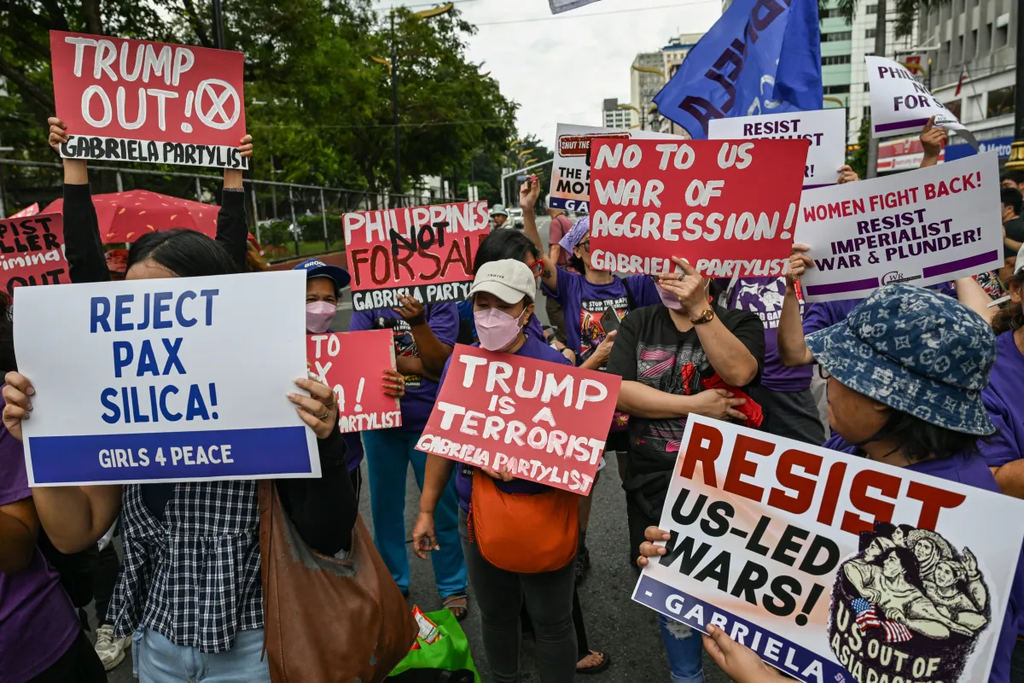
Earlier this week, student groups held a demonstration against the threat of U.S. investment in AI data centers and members of GABRIELA, a political organization for women in the Philippines, staged a protest against Trump’s upcoming visit and the proposed Pax Silica. Posters at the demonstration read: “Shut the Pax Down” and “Philippines Not For Sale.”
Earlier this week, student groups held a demonstration against the threat of U.S. investment in AI data centers and members of GABRIELA, a political organization for women in the Philippines, staged a protest against Trump’s upcoming visit and the proposed Pax Silica. Posters at the demonstration read: “Shut the Pax Down” and “Philippines Not For Sale.”
But environmental concerns, however, are troubling for grassroots organizations and indigenous communities.
The Center for Environmental Concerns – Philippines (CED) and other environmental groups are pushing back, aiming to protect the natural resources and communities of the country against “foreign control and corporate plunder.”
“Our lands, forests, water, and minerals must sustain our communities and serve the Filipino people’s needs,” CED said in a statement last month. “They must not be placed at the disposal of foreign corporations or sacrificed to the United States’ pursuit of technological and military dominance.”
The increase in mining and development specifically threatens thousands of acres of ancestral lands, cultural survival and the livelihood of indigenous Aeta communities.
When Will the Pax Silica Deal Be Signed?
Philippines Department of Trade and Industry (DTI) Undersecretary Ceferino S. Rodolfo told reporters at the ASEAN Investment Forum on Tuesday that the deal won’t be signed at the summit, noting that the key players didn’t want the agreement to compete with “an already crowded diplomatic agenda.”
“Other key regional diplomatic and geopolitical initiatives deserve the dedication they merit, particularly given the unique visibility that only an ASEAN summit provides,” he said. “We do not want to distract attention or take away attention from the regional initiatives that ASEAN and the Philippines are promoting.”
He added that he believes the deal will be signed by the end of the year.
U.S. Ambassador to the Philippines Lee Lipton said the signing of the Pax Silica was never on the table for the ASEAN Summit.
“Decisions will be made in full consultation with the government of the Philippines at the appropriate time,” he said in a statement. “As stated previously and as part of this process, we expect rigorous discussions on impacts to all stakeholders.
“We look forward to working alongside the government of the Philippines about this exciting initiative to secure supply chains and attract quality investment in support of economic growth and jobs at home for the Filipino people.”
What Is the Timeline for Pax Silica?
At the inaugural summit for Pax Silica, Japan, the Republic of Korea, Singapore, the Netherlands, the United Kingdom, Israel and Australia signed on. More countries joined throughout 2026, including Argentina, Chile, Costa Rica, El Salvatore, Finland, Germany, Greece, India, Italy, Kazakhstan, Norway, Panama, Paraguay, the Philippines, Qatar, Sweden, the United Arab Emirates and the European Union. Additionally, 54 countries signed the related AI Opportunity Statement, which commits to a cooperative approach to AI growth and regulation.
Under Secretary of State for Economic Affairs Jacob Helberg is busy talking to foreign allies about next steps for AI infrastructure growth. On Tuesday, Helberg announced a first-of-its-kind tin refining plant in Virginia is set to begin production in 2027, thanks to a partnership with the Democratic Republic of the Congo. Helberg said this is the “Pax Silica and the U.S.-DRC Strategic Partnership Agreement at work.”
Newsweek has reached out to the White House, GABRIELA, UP SAPAX Network and the Office of the President of the Philippines for comment.
Reposted from Newsweek


Happy
0 %

Sad
0 %

Excited
0 %

Sleepy
0 %

Angry
0 %

Surprise
0 %
 0
 0