Read Time:2 Minute, 59 Second
The Philippine economy unexpectedly slowed for a fifth straight quarter, raising questions about the central bank’s rate-hike cycle and heaping pressure on President Ferdinand Marcos Jr.
Gross domestic product expanded 2.1% in the three months to September from a year earlier, the statistics agency said Monday. That compares to 2.4% in the second quarter and was a full percentage point below the median estimate of 3.1% in a Bloomberg News survey.
Agricultural output fell 4.8% in the third quarter, and services growth continued to slow. Farm output was hurt as typhoons battered the climate-vulnerable nation, with El Nino further clouding the outlook.
The peso fell 0.3% and the benchmark stock index dropped as much as 0.7% after the data release, which underscores how deeply the nation is underperforming neighboring economies. Growth was less than half the pace seen in Indonesia or Malaysia, and less than a quarter that of Vietnam.
The data underscore the damage to the Philippines from the U.S.-Iran war, which has driven up crude oil prices and inflation, forcing the central bank to hike interest rates. The resulting higher cost of living and still-unresolved government corruption scandals have weakened consumer and business confidence.
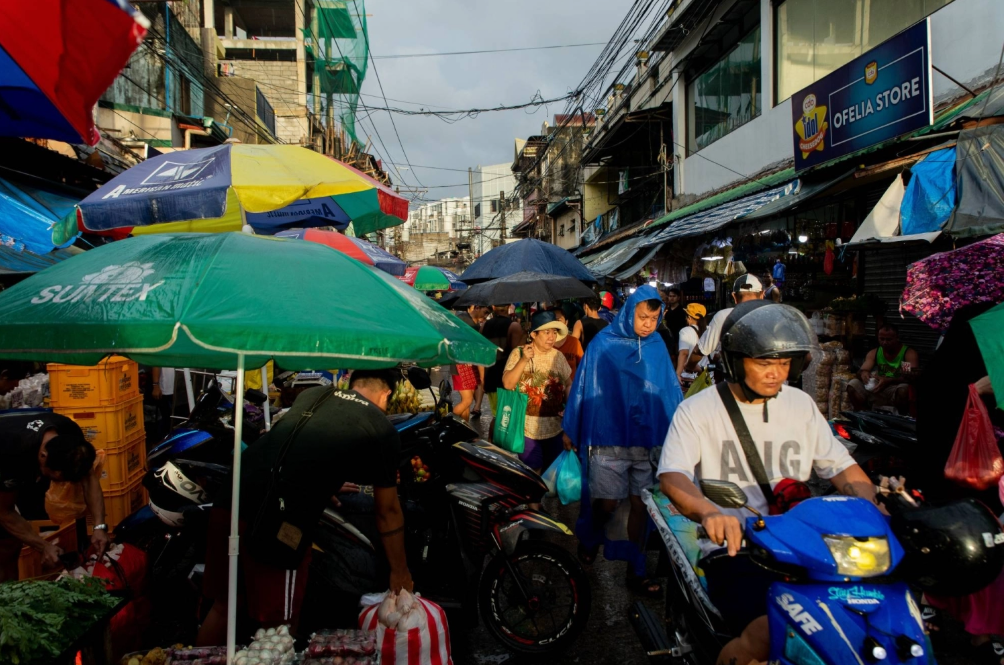
High food and energy prices constrained consumer spending, a key economic driver which continued to post slower growth. Tighter financial conditions weighed on investments which remained in contraction. Cyclones and the monsoon disrupted farm production, which reduced rural incomes and added to supply pressures.
The data come days after the release of the latest inflation print showing an acceleration to 7.8% in October, the fastest pace in almost four years. That was expected to lead the central bank to continue raising rates following a jumbo 50-basis-point hike in October.
Economic Planning Secretary Arsenio Balisacan refrained from calling on the Bangko ng Sentral Pilipinas to pause its rate hikes, noting the central bank is trying to cool price gains.
“If the BSP actually succeeds in anchoring the inflation expectation back to the target, then that actually will impact positively consumption and investments,” he said at a briefing in Manila. “It’s not necessarily bad for growth.”
Still, he said achieving the 2026 growth target of 3.5% to 4.5% is “very challenging at this point given the current environment but we are hoping that the fourth-quarter performance will be better.”
The BSP now must weigh the weak economy against surging prices and support for the peso, which has dropped almost 7% to be Asia’s second-worst-performing currency this year. Inflation has remained well above the central bank’s 3% goal since March.
“While we think they should still deliver more jumbo hikes, they may opt for a smaller hike in December because of growth concerns,” said Bank of the Philippine Islands lead economist Emilio Neri Jr. A small hike could leave the peso under greater pressure, he added.
“This could also increase the possibility of inflation getting de-anchored,” Neri said. “Core inflation is just rising too fast.”
Marcos will also face pressure to act to support the economy, which is heavily dependent on imported energy from the Middle East.
Growth started to slow in the third quarter of last year. At that time, confidence began a lengthy slump after Marcos revealed corruption in government involving billions of pesos in flood-related infrastructure. The graft scandal is unresolved, while Vice President Sara Duterte, who denies wrongdoing, is on trial in the Senate over alleged unexplained wealth.
Reprinted from The Japan Times


Happy
0 %

Sad
0 %

Excited
0 %

Sleepy
0 %

Angry
0 %

Surprise
0 %
 0
 0