Read Time:4 Minute, 25 Second
Move, while incremental, underscores unrest over Trump’s unilateral military abduction of Maduro among some Republicans.
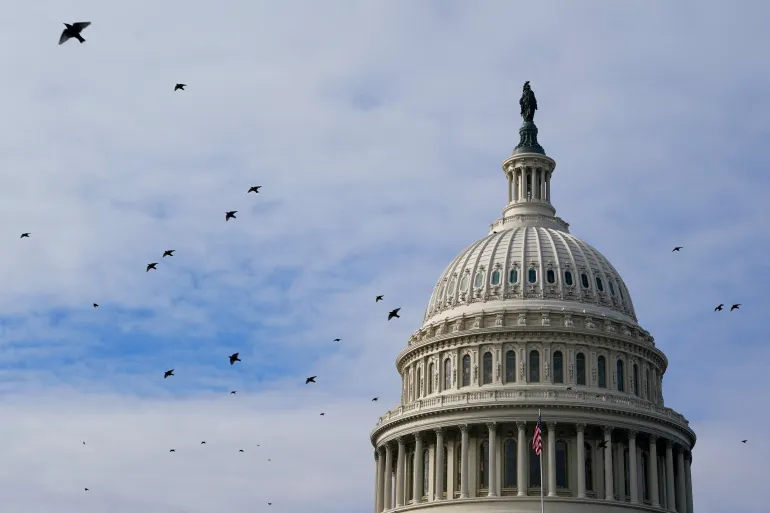
The US Senate has advanced a resolution that would bar President Donald Trump from taking further military action against Venezuela without congressional authorisation.
The vote on Thursday on the procedural measure to advance the war powers resolution was 52 to 47. Several members of Trump’s Republican Party broke with the president to join every Senate Democrat in voting in favour of moving ahead.
If eventually passed, the resolution would require Trump to remove US armed forces from “imminent engagement” in hostilities “within or against Venezuela” without further approval from Congress.
The resolution will now go to a full floor debate in the Senate. It must be passed by both Chambers of Congress to reach Trump’s desk. The president could then veto the resolution. Overriding the veto would require two-thirds support from both the Republican-controlled House and Senate, a likely insurmountable threshold.
Still, observers hailed Thursday’s vote as symbolically significant, underscoring discontent over Saturday’s abduction of Venezuelan President Nicolas Maduro in a dramatic military raid in Caracas, as well as Trump’s threats to again attack Venezuela and other countries in the region.
In a post on X, Dylan Williams, vice president for government affairs at the Center for International Policy, called the move “a major rebuke” to Trump.
Cavan Kharrazian, senior policy director for the Demand Progress advocacy group, called the vote “a rare ray of good news for the nation and our Constitution”.
“With this historic, bipartisan vote to prevent further war in Venezuela, Congress has begun the long-overdue work of reasserting its constitutional role in decisions of war and peace,” Kharrazian said.
Several attempts to advance similar resolutions were blocked by both the Senate and House last year, with Republicans largely coalescing around support for Trump. The five Republicans who voted to advance on Thursday included senators Rand Paul, Lisa Murkowski, Susan Collins, Todd Young and Josh Hawley.
Their vote appeared to hit a nerve for Trump. In a post on Truth Social, Trump said the Republican quintet should be “ashamed” and “should never be elected to office again”.
It was not immediately clear when a final vote on the Senate resolution would be held, although it was expected ssometimenext week.
‘Clear-cut case’
US military assets have remained deployed to the Caribbean since the abduction of Maduro and the Trump administration has said strikes on alleged drug boats will continue.
While no US troops are known to be on the ground in the country, Trump has threatened interim leader, Maduro’s former deputy Delcy Rodriguez, that if she does not comply with US demands, she could “pay a very big price, probably bigger than Maduro”.
Trump has also threatened to use military force against other countries in the Western Hemisphere, including Colombia, as well as Greenland – an autonomous territory of Denmark. How the US military will play into Trump’s promises to indefinitely assert control over Venezuela’s government and open the country’s oil industry to US companies has not yet been clarified.
Legal experts have said Congress has, for decades, backed away from asserting its authority when it comes to US military engagement abroad.
Under the US Constitution, only Congress can declare war, something it has not done since World War II.
The War Powers Act of 1973, meanwhile, created a process for the legislative branch to rein in a president’s unilateral use of the military. Many experts argue the Constitution only grants the president the ability to take unilateral military actions in matters of immediate self-defence or in responding to an imminent attack.
Speaking to Al Jazeera earlier this week, David Janovsky, the acting director of the Constitution Project at the Project on Government Oversight, called Trump’s actions in Venezuela a “clear-cut case” of presidential overreach “crying out for congressional action”.
‘No more endless wars’
But many Republicans have rejected that position, adopting Trump’s claims that the US needed to take urgent action against Maduro, even as little evidence has emerged to justify the position.
“Unlike the former president, President Trump demonstrated he is a man of action, he was decisive, and did what he promised the American people he would do, and that is to keep them safe,” Senator James Risch said before Thursday’s vote.
Risch further argued that actions against Maduro were a one-off “47-minute” operation, and not part of a prolonged military engagement, and therefore did not require congressional intervention.
The top Democrat in the chamber, Chuck Schumer, meanwhile, called on the Senate to assert “the authority given to it in the Constitution on matters of war and peace”.
“We must send Donald Trump a clear message on behalf of the American people, no more endless wars,” he said.
In an editorial published by Responsible Statecraft on Wednesday, Republican Rand Paul accused his party of having “lost its grip and become eunuchs in the thrall of presidential domination”.
“But make no mistake, bombing another nation’s capital and removing their leader is an act of war plain and simple,” he said. “No provision in the Constitution provides such power to the presidency.”
Reposted from Al Jazeera


Happy
0 %

Sad
0 %

Excited
0 %

Sleepy
0 %

Angry
0 %

Surprise
0 %
 0
0
 0
0