Read Time:6 Minute, 5 Second
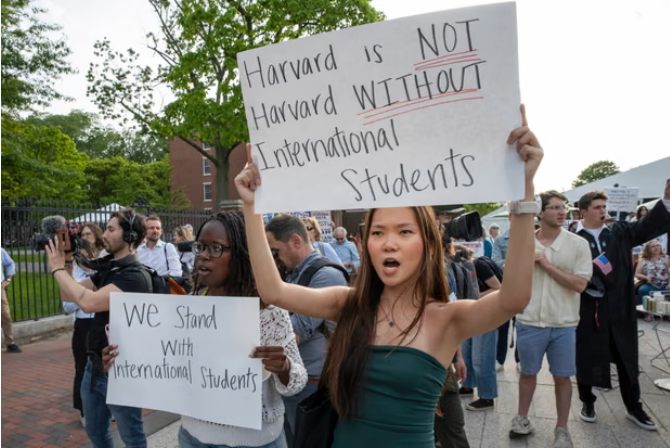
Trump’s immigration crackdown drives international students away from US universities
Until 2025, students from Brazil, Nigeria, Thailand, Turkey, Turkmenistan and Zambia eagerly accepted a full scholarship to attend Indiana University in Bloomington, a town in the midwestern United States where fans are passionate about the Hoosiers – the school’s basketball and football teams.
The town also hosts the Little 500, a famous bicycle race that can attract more than 25,000 people. And most importantly for prospective students, the school has well-regarded academic programs.
“There was a general sense that this was the beginning of a great new phase in people’s lives,” said Christoph Irmscher, who for 13 years directed the Wells Scholars Program, which covers the full costs of attendance, including living expenses.
But things changed in January 2025, when Donald Trump started his second term and launched a shocking immigration crackdown.
That year, Irmscher offered the award to a Black man from South Africa and a woman from Central America. Both declined.
“People are cautious now, and it’s more like weighing the benefits versus the disadvantages” and whether to take a risk, said Irmscher, who grew up in Germany and came to the United States in 1993 on a scholarship through the Fulbright Program, a federal initiative.
That hesitation appears to be increasingly common among international students, and the number who enroll at American schools has plummeted in the last two years.
Their absence on campuses takes money away from colleges, causes a brain drain and robs American students of the chance to meet their counterparts from around the world. It also ripples out into the wider economy – especially in the many small college towns dotted across the US.
In fall 2026, there was a 15% decrease in foreign students studying for the first time at a US college or university as compared to last year, according to the Institute of International Education. That follows an 18% dip in fall 2025.
That enrollment drop cost Cleveland State between $2m and $4m, Sridhar estimated. International students typically pay a higher tuition than domestic students.
There are also, of course, less tangible ways foreign students affect US colleges, including in social life.
Sridhar, a former computer science professor who came to the United States from India in 1999 to attend graduate school at Ohio State University, said that international students bring “a diverse group of viewpoints to campus in various kinds of conversations, whether they are in the classroom or outside the classroom”, which creates a “richness and intellectual diversity”.
After a 2025 earthquake in Myanmar killed thousands and left millions needing humanitarian assistance, a student from the country studying at Indiana University organized a fundraiser with Burmese food where she spoke about the country.
“It was not just a culturally enriching event. It was also an exercise in putting yourself into the shoes of somebody else in ways that are normally not accessible to students in landlocked America,” Irmscher said.
When students come here to study, they also sometimes immigrate, like Irmscher and Sridhar, and positively impact American society. The Trump administration tried to obstruct that path by introducing a rule in July 2026 that prohibited student visa recipients from staying in the country for more than four years without federal government approval. It often takes longer than that to complete a degree.
Dubal, who is also a law professor at the University of California, Irvine, is the daughter of Indian immigrants who came to the United States in the 1960s to study and pursue careers. Her father, a biochemist, had a blood testing laboratory in Houston; her mom, a physician, had pain clinics in Lexington, Kentucky.
“She spent the entirety of her career helping people who were often poor from underserved communities, from rural communities, who had occupational injuries as a result of mining, as a result of factory work, and both of them spent their lives contributing immensely to their communities,” Dubal said.
DHS denies its actions have significantly driven away foreign students and adversely affected schools.
“This ‘reporting’ is completely misleading and not backed up by any real evidence,” a spokesperson stated in an email to the Guardian. “The performative outrage is incredible. Where was the outrage when foreign nationals were abusing the system, violating the terms of their student visas, and making a mockery of our immigration laws? If the media really cared about legitimate international students, they would be thanking President Trump for cracking down on the rampant fraud to ensure only those truly intending to study in the United States are given the privilege.”
Asked for evidence of “rampant fraud”, the agency did not respond.
In October, the Trump administration announced it would investigate nine universities to determine if they committed fraud through a student visa program.
“Something weird is going on at these universities,” vice-president JD Vance said. “They are using these visas way too much. They are using them to undercut the wages of American grad students.”
The administration has not been entirely successful in trying to implement new restrictions on international students hoping to study in the country. This week, a federal judge blocked the rule that limited students’ stays in the United States to four years.
“Put bluntly, DHS is seeking to prevent or discourage the very activity—providing educational opportunities for foreign students in the United States—that Congress sought to permit and encourage,” the judge stated.
Dubal is optimistic – particularly in the wake of the Democrats’ wins in the midterm elections – that higher education can overcome the Trump administration’s treatment of foreign students. Rather than focus on keeping them out, lawmakers should instead concentrate on reducing the cost of higher education, she said.
“If the Trump administration cares about whether or not native-born Americans are getting access to higher education, the answer to that is not to push out immigrants,” Dubal said. “It is to make it more accessible. And how do you make it more accessible? You lower the prices.”
Reprinted from The Guardian


Happy
0 %

Sad
0 %

Excited
0 %

Sleepy
0 %

Angry
0 %

Surprise
0 %
 0
 0